A quoted dryer price is meaningful only when it states water evaporation rate, product moisture, belt loading, residence time, utilities, and the equipment included. By the end, you will be able to estimate your required capacity, compare dryer types, assess supplier trials, and request a like-for-like delivered quotation in Noida.
Key takeaways
- Budget ₹8 lakh for a small simple unit and over ₹1 crore for a high-capacity system.
- Size the dryer using feed rate, inlet moisture, target moisture, and residence time.
- Match belt, cabinet, tunnel, or multi-zone drying to the product and heat sensitivity.
- Compare suppliers on airflow control, automation, installation, commissioning, and after-sales support.
What Determines Continuous Dryer Machine Price in Noida?
Set a preliminary budget of about ₹8 lakh for a small, simple continuous conveyor or cabinet-style unit, and more than ₹1 crore for a high-capacity, multi-zone dryer with recirculation, automation, insulation, installation, and commissioning.
This industrial food dryer price is only a planning range: the continuous dryer machine price in Noida depends more on evaporation than advertised product throughput. A “500 kg/h” machine means little until the supplier states wet-feed or finished-product capacity and feed moisture of 25%, 35%, or 50%.
Request these figures as separate quotation lines:
- Water evaporation capacity in kg/h and the moisture basis
- Belt width, length, usable drying area, bed depth, residence-time range, and loading
- Number of zones, air velocity, recirculation ratio, exhaust rate, heat source, and utility load
- Product-contact steel grade, conveyor construction, insulation, controls, sensors, and exhaust treatment
- Dryer price, heating system, panel, freight, ducting, chimney, foundations, utilities, installation, commissioning, and taxes
| Specification | Lower-cost unit | Higher-cost unit |
|---|---|---|
| Drying layout | One or two zones | Multiple independently controlled zones |
| Air system | Limited recirculation | High recirculation with controlled exhaust |
| Construction | Basic stainless-steel contact surfaces | Hygienic, insulated, sealed construction |
| Product basis | Dense, uniform products | Light snacks requiring bulk-density and airflow design |
Poorly drained frames, exposed insulation, crevices, and inaccessible fan housings add cleaning risk. For snacks and chips, belt area alone cannot predict capacity: bulk density, piece size, bed depth, and allowable breakage also change the quotation.
How to Size the Dryer from Moisture and Production Demand
A dryer’s real capacity is the kilograms of water it removes per hour, not the headline product throughput. Convert the moisture figures on a wet basis before comparing a commercial continuous dryer or an industrial food dryer price.
1. Calculate dry solids: feed rate × (1 − inlet moisture). For 500 kg/h entering at 35% moisture, solids equal 325 kg/h.
2. Calculate finished-product rate: dry solids ÷ (1 − target moisture). At 12% outlet moisture, the result is 369.3 kg/h.
3. Calculate evaporation: feed rate − finished-product rate, or feed rate × (inlet moisture − target moisture) ÷ (1 − target moisture). This example requires 130.7 kg of water removal per hour.
4. Convert the daily requirement into hourly demand by dividing total wet feed by stable operating hours, then add capacity for cleaning, changeovers, and planned downtime. Do not divide by the shift length if the dryer runs only part of that shift.
Give the supplier the product thickness, bulk density, shape, stickiness, heat limit, and allowable residence time. A dense pasta layer and a light extruded snack need different belt loading and airflow even at the same moisture reduction. Thickness controls the distance moisture must travel; bulk density affects how much product occupies each square metre.
Request a written capacity basis stating wet-feed kg/h, inlet and outlet moisture, evaporation kg/h, belt loading, residence time, and ambient conditions. Record energy consumed per kilogram of water evaporated during acceptance trials; heater size alone cannot prove efficient drying.
Which Dryer Type Fits Pasta, Noodles, Snacks, Chips, and Coated Foods?
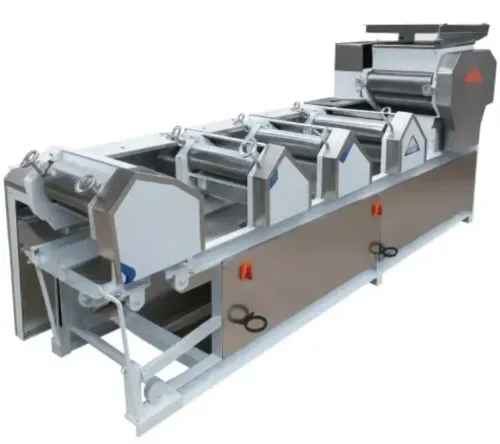
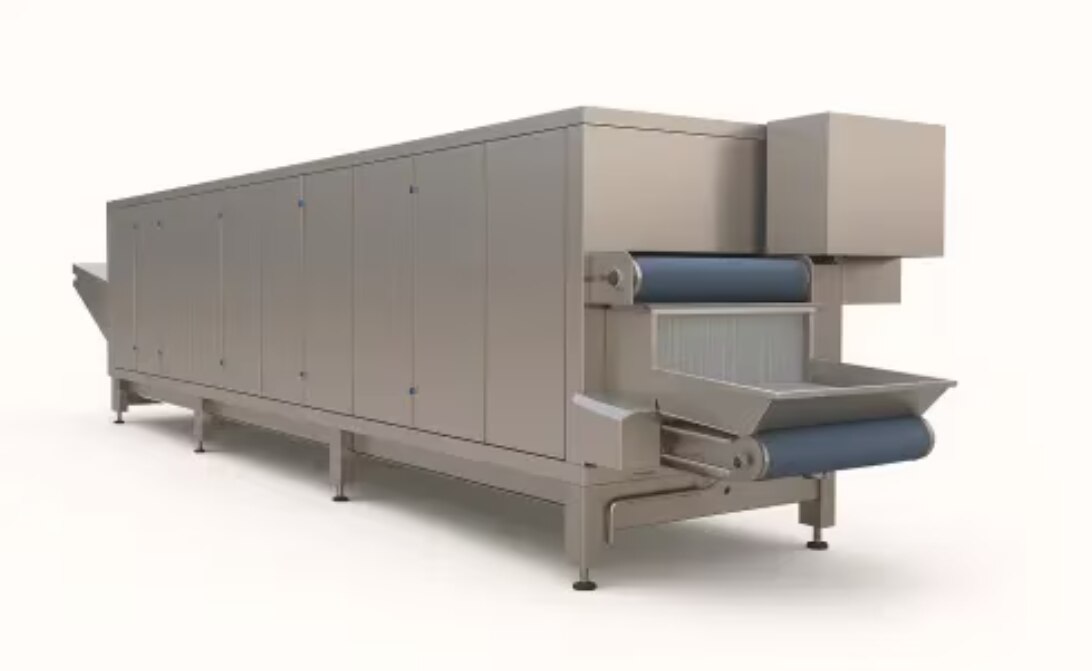
A continuous conveyor dryer fits a steady, high-volume feed of similarly sized pieces that can travel in a controlled bed. It suits pasta, noodles, extruded snacks, chips, and coated foods when you need repeatable residence time, staged heating, and automatic discharge rather than batch handling.
| Type | Best fit | Choose another when |
|---|---|---|
| Continuous conveyor | High-volume pasta, noodles, snacks, chips, and coated pieces | Feed rate changes sharply or products need separate small batches |
| Tray dryer | Small batches, irregular shapes, trials, and heat-sensitive products | Labour-intensive loading and unloading would limit output |
| Tunnel dryer | Long products or large-scale staged drying with defined airflow zones | You need rapid drying of a shallow, freely moving bed |
| Fluid-bed dryer | Small granules, pellets, and light snacks requiring strong air contact | Pieces are sticky, fragile, too large, or prone to attrition |
| Rotary dryer | Free-flowing grains, pellets, and robust irregular pieces | Product breaks under tumbling or coating must remain intact |
| Freeze dryer | Premium, highly heat-sensitive foods where structure and aroma matter | Capital, cycle time, and operating cost must stay low |
For pasta and noodles, select a multi-zone conveyor or tunnel system with controlled temperature and relative humidity. A single hot chamber can dry the surface faster than the core, causing cracks or deformation.
For expanded snacks, compare usable belt area and airflow, not only kg/h; low bulk density makes volume and bed depth decisive. Ask any food processing dryer in Noida supplier to demonstrate moisture uniformity, breakage, cleanability, and drainage.
A commercial continuous dryer is the wrong choice if sanitation access, product changeover, or feed consistency cannot be proven.
How Airflow, Belt Loading, and Drying Zones Affect Product Quality
Moisture uniformity depends on more than chamber temperature: airflow distribution, belt loading, residence time, and staged drying zones determine whether product leaves evenly dry or develops a wet core, cracks, sticks, or overheats. A commercial continuous dryer needs cross-belt testing, not one average temperature reading.
1. Set belt loading by kilograms per square metre and spread product in one consistent layer. An overloaded belt blocks air, increases residence time, and leaves the centre wet; an underloaded belt dries product too quickly and raises heat damage and breakage.
2. Balance airflow across the belt. Unequal fan pressure or blocked filters create hot and cold strips, causing simultaneous over-drying and under-drying. Check moisture samples from the left, centre, and right belt positions at several loads.
3. Use drying zones with separate temperature, relative-humidity, and exhaust settings. Pasta and noodles need gradual moisture removal so the surface does not seal before water migrates from the core; a constant high temperature can cause cracking, deformation, or a dry surface around a wet centre.
4. Control product temperature, not only air temperature. Reduce heat input or increase belt speed when snacks brown, coated foods stick, or chips blister. Confirm residence time, inlet and outlet moisture, and product temperature during trials with the food processing dryer in Noida.
Ask for mapped temperatures and moisture results at minimum, nominal, and maximum belt loading before accepting the dryer.
How to Compare Continuous Dryer Suppliers in Noida
Reject any quotation that gives only belt width and product throughput. Compare continuous dryer suppliers in Noida using evaporation capacity in kilograms of water removed per hour, with feed moisture, target moisture, belt loading, operating hours, and wet-feed or finished-product basis stated.
Before ordering, send every bidder the same product sample and test brief. Require:
- A trial report showing inlet and outlet moisture, residence time, belt speed, product load, and energy use.
- Temperature mapping across the belt at several loads, with samples from the centre and both edges.
- A cleanability inspection covering welds, drain points, fan housings, hollow sections, exposed insulation, and product-contact surfaces.
- General-arrangement drawings, stainless-steel grade, motor list, heat-source details, exhaust volume, compressed-air demand, and electrical load.
- A commissioning and acceptance clause that defines maximum moisture variation, capacity, surface temperature, and reject conditions.
Separate these costs before comparing the continuous dryer machine price in Noida:
| Quotation item | Demand in writing | Why it matters |
|---|---|---|
| Machine | Belt area, zones, airflow, controls, and product-contact material | Prevents a narrow belt or weak specification hiding capacity limits |
| Utilities | Burner or heater, gas train, chimney, exhaust treatment, panels, cables, and foundations | Exposes the delivered cost beyond ex-works price |
| Services | Freight, erection, commissioning, training, warranty, and taxes | Prevents an artificially low headline quote |
| Spare parts | Belts, bearings, sensors, heaters, and recommended stock | Shows future downtime and maintenance exposure |
If you compare Shan Engineerings Works with another bidder, use this identical test sheet rather than the lowest headline figure.
Related product
 | Continuous Dryer A conveyor dryer is an advanced continuous drying system designed to transport products through a temperature-controlled heated chamber using a... View product → |
Frequently asked questions
What determines continuous dryer machine price in Noida?
Price depends on dryer capacity, number of drying zones, recirculation, automation, insulation, conveyor size, installation, and commissioning. A small simple unit may cost about ₹8 lakh, while a high-capacity multi-zone system can exceed ₹1 crore.
How do you size a continuous dryer from moisture and production demand?
Use hourly feed rate, inlet moisture, target moisture, drying temperature, and required residence time. The dryer must remove the calculated water load without overloading the belt or shortening the product’s required drying time.
Which dryer type fits pasta, noodles, snacks, chips, and coated foods?
Select the dryer according to product shape, moisture level, heat sensitivity, surface coating, and target texture. Conveyor, cabinet-style, tunnel, and multi-zone dryers suit different production and drying requirements.
How do airflow, belt loading, and drying zones affect product quality?
Airflow removes surface moisture, belt loading controls exposure, and separate zones let you adjust temperature and humidity through the process. Poor settings can cause uneven moisture, sticking, cracking, case hardening, or excess browning.
How should you compare continuous dryer suppliers in Noida?
Compare suppliers using a written capacity calculation, product trial results, airflow and temperature controls, hygienic construction, automation scope, installation plan, commissioning support, spare parts, and after-sales service.
Keywords