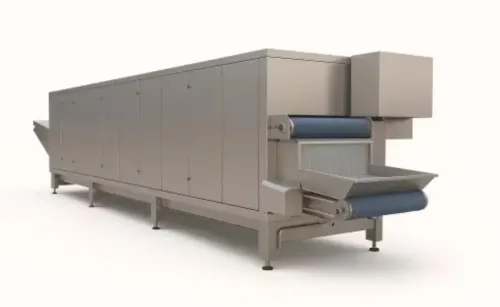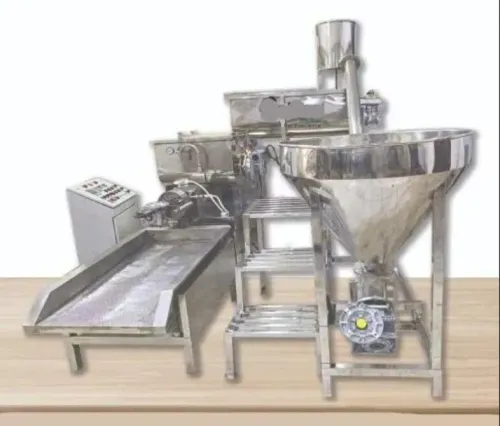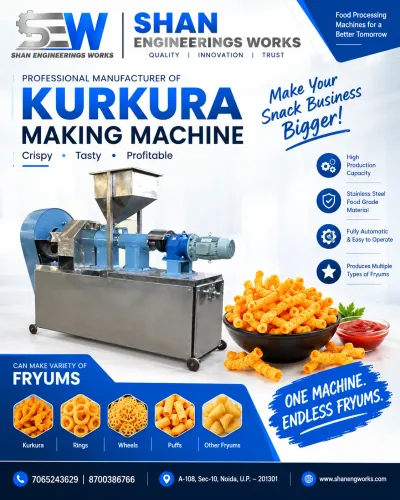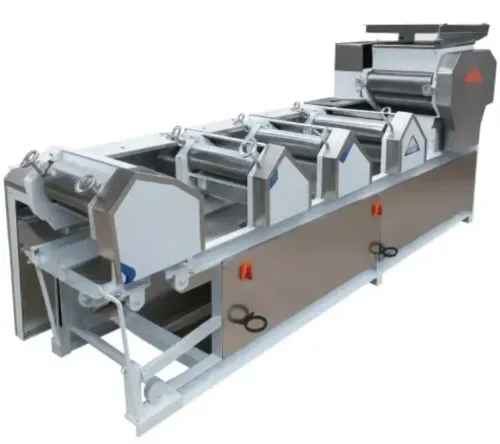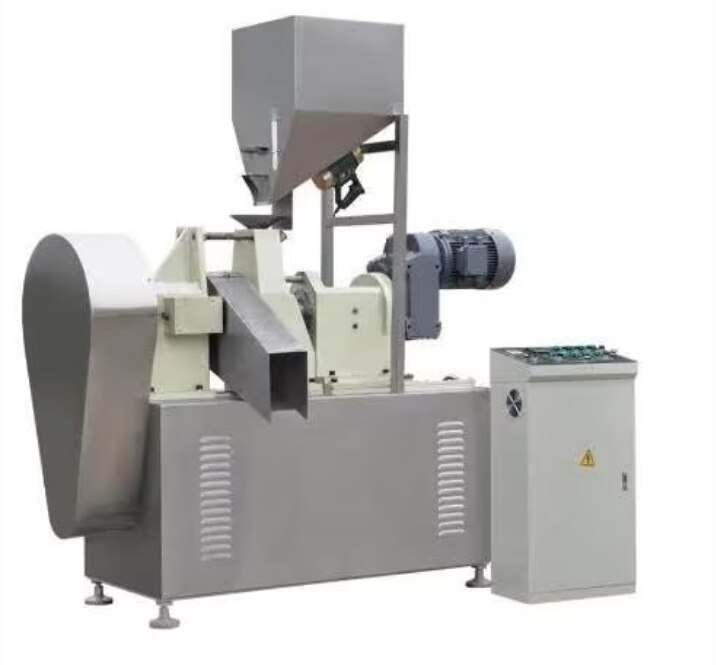
A Kurkure line improves production only when the extruder, fryer or dryer, seasoning system, and packer are sized around the same saleable output. You will be able to judge the right capacity, compare fried and dried processing, calculate payback, and test a supplier before committing capital.
Key takeaways
- Evaluate the complete line, not the extruder alone.
- Match capacity to daily demand, labour and available utilities.
- Compare frying with hot-air drying using product quality and operating costs.
- Demand trials, utility figures, drawings and service terms before ordering.
How does a Kurkure line turn a recipe into saleable snack?
A Kurkure line converts cornmeal, flour, or grits into a saleable snack by controlling every stage, not by relying on the extruder alone. The process doses the recipe, mixes dry ingredients, adds water, and conditions the feed before extrusion cooking.
The cooked mass passes through a die, where die geometry creates shape and expansion; a synchronized cutter sets piece length. Pieces then go to frying or hot-air drying, followed by de-oiling or cooling, seasoning, final cooling, and moisture-barrier packing.
- Ask the supplier to define flour or grit particle size, incoming moisture, recipe tolerance, water addition, die geometry, barrel temperature, screw speed, feed rate, cutter speed, residence time, frying or drying temperature, and final moisture. These controls determine density, cell structure, colour, breakage, seasoning adhesion, and shelf stability.
- Treat a capacity claim as incomplete unless it names the recipe, input moisture, die, piece dimensions, finished moisture, and process method. A kilogram-per-hour figure can describe feed entering the machine rather than good product leaving the packer.
- Investigate dense pieces, poor expansion, cracks, irregular lengths, excess oil, colour variation, seasoning loss, clumping, or high moisture as process-control failures. Check feed stability, temperature, cutting, frying or drying, and packing before blaming the extruder.
Automatic dosing, temperature control, screw-speed control, and synchronized cutting are key Kurkure production machine benefits, but repeatability still depends on consistent raw material and downstream equipment. A fryer, dryer, seasoning drum, cooler, or packer can become the bottleneck.
Which production scale benefits from an extruder for namkeen manufacturer use?
A small unit benefits from an extruder only when demand is steady enough to keep it productive; a growing regional brand usually gains the clearest return from repeatable geometry and faster scaling.
| Scale | Lower-cost alternative | Commercial Kurkure machine for business |
|---|---|---|
| Small, low-volume unit | Manual shaping or semi-automatic forming; low capital cost, but high operator dependence and variable length | Difficult to justify unless one standard SKU sells regularly |
| Growing regional brand | Semi-automatic equipment handles modest batches but needs more labour and longer changeovers | Strong fit for repeat orders, consistent pieces, and expansion capacity |
| High-volume factory | Limited throughput and labour-intensive control | Best fit when a dedicated line feeds frying, seasoning, and packing continuously |
Separate rated capacity from saleable output. Start-up rejects, die changes, fryer losses, seasoning loss, packaging stoppages, and downtime reduce the kilograms you can sell; request demonstrated good-product output and yield.
Map labour before buying an extruder for namkeen manufacturer use:
- Loading and dosing, operation, die and cutter changes
- Cleaning, seasoning, packing, and quality checks
Choose a flexible existing extruder for multiple shapes, recipes, and frequent short runs. Choose a dedicated line for a high-volume core SKU when repeatable dimensions and low changeover frequency outweigh its cleaning, electrical, and space demands. Low demand, seasonal sales, limited electrical supply, or insufficient downstream space favour semi-automatic equipment instead.
Should the line fry or hot-air dry, and what must a Noida plant provide?
Frying suits expanded, crunchy Kurkure-style snacks when rich flavour and fast finishing matter; hot-air drying suits lower-fat products and simpler oil control. The kurkure machine benefits for snack production in Noida depend on matching the route to texture, throughput, and available utilities.
| Route | Texture and product fit | Oil, energy, space, and shelf-life |
|---|---|---|
| Extrusion plus frying | Crisp, blistered, strongly flavoured snacks; suitable for classic Kurkure, rings, and pellets | High oil use; requires filtration, de-oiling, cooling, and uniform heat. Compact cooking time, but oil oxidation raises rancidity risk. Season only after surface oil is controlled. |
| Extrusion plus hot-air drying | Drier, lighter snacks with less fried flavour; suitable for reduced-fat shapes and products needing no frying oil | No oil filtration or de-oiler, but blower power, heat removal, residence time, and dryer footprint increase. Stable final moisture supports shelf life when packed correctly. |
For frying, verify temperature uniformity across the oil zone, oil turnover, filter capacity, residence time, and cooling. Hot spots darken pieces; low turnover and poor filtration increase fines, oil uptake, rancidity, and weak seasoning adhesion.
- Size the complete line: mixer, feeder, fryer or dryer, blower, oil pump and filter, seasoning drum, cooling conveyor, compressor, electrical panel, and packaging machine.
- Confirm connected load, phase, voltage, compressed-air demand, water, exhaust, drainage, floor area, ventilation, heat removal, and cooling capacity for Noida’s hot, humid conditions.
- Specify food-contact stainless steel grade and finish; inspect smooth welds, no dead spots, removable parts, lubricant controls, and cleaning access.
- Document FSSAI licensing, hygiene, allergen segregation, cleaning, and time-temperature controls. Use moisture-barrier packaging and cool product before packing, or condensation will soften it.
How can you prove the machine will pay for itself?
A payback claim is useful only when it starts with your quoted purchase and installation cost, then uses contribution from saleable product rather than the extruder’s nameplate capacity.
Calculate monthly contribution as selling price per kilogram minus utilities, oil or drying energy, labour, packaging, maintenance, and wastage; multiply it by actual saleable kilograms per hour, operating hours per day, and operating days. Divide the total investment by monthly contribution for simple payback.
- Define the acceptance target before ordering: recipe, flour or grits, input moisture, die, cutter, seasoning, finished moisture, bulk density, piece length and diameter, oil temperature where frying applies, and maximum reject percentage.
- Run the trial with your own flour or grits, recipe, input moisture, die, cutter, and seasoning. Do not accept a demonstration using an easier formulation.
- Require the supplier to record good-product output after start-up waste, rejects, fryer losses, seasoning loss, stoppages, and packaging interruptions. Record reject percentage, final moisture, bulk density, piece dimensions, oil uptake, power consumption, start-up waste, and cleaning time.
- Repeat the test after changing shapes, colours, flavours, and recipes. Measure die replacement, seasoning and allergen cleaning, purge material, stabilisation time, and the time needed to restore product quality.
These records expose the real kurkure production machine benefits: repeatable output and lower operator variation, not an attractive motor rating. Include every measured loss in the payback model; otherwise, the result prices a machine that cannot sell its quoted capacity.
What should a Noida buyer demand before ordering?
A quotation for a commercial kurkure machine for business must describe the complete line, not only the extruder. The kurkure machine benefits for snack production in Noida disappear if the fryer, seasoning drum, or packer becomes the bottleneck.
1. Demand rated and demonstrated saleable capacity, with the test recipe, input moisture, finished moisture, piece dimensions, bulk density, die and cutter configuration, recipe range, motor and heater ratings, and contact-part material stated. List every included item: mixer, feeder, fryer or dryer, oil filtration, seasoning, cooling, compressor, controls, and excluded utilities.
2. Inspect safety provisions before ordering: guards around the cutter and drive, emergency stops, thermal and overload protection, hot-surface protection, and a written blocked-die clearing procedure. Ask for electrical drawings, connected load, phase, voltage, air demand, ventilation, drainage, and heat-removal requirements for your Noida site.
3. Require a spares schedule covering screws, barrel liners, dies, cutters, bearings, heaters, sensors, belts, oil pumps, and control components. It must state replacement intervals, Noida stock levels, and lead times.
4. Put installation, commissioning, operator training, warranty, service-response times, manuals, cleaning instructions, food-contact declarations, and trial records into the purchase order. Record good-product output, rejects, power use, final moisture, and cleaning time; check the recipe and equipment against FSSAI controls.
Shan Engineerings Works belongs on your comparison list only if it supplies this evidence and supports the mixer-to-packer line, rather than leaving you to integrate an extruder alone.
Frequently asked questions
How does a Kurkure line turn a recipe into saleable snack?
The line doses and mixes cornmeal, flour or grits, adds water, conditions the feed, and extrusion-cooks it. Cutting, shaping, frying or drying, seasoning, cooling and packing then determine the finished product’s texture, weight and shelf stability.
Which production scale benefits from an extruder for namkeen manufacturer use?
An extruder suits a namkeen manufacturer when repeatable output, controlled shape and lower manual handling justify the investment. Compare the machine’s hourly capacity with your confirmed demand, shift length, labour cost, recipe range and available power before choosing a size.
Should a Noida plant fry or hot-air dry Kurkure snacks?
Frying delivers the familiar crisp texture and fast heat transfer but adds oil management, filtration and wastewater concerns. Hot-air drying reduces dependence on frying oil but requires controlled airflow, longer residence time and careful moisture management. Select the method from your product specification and operating-cost calculation.
How can you prove a commercial Kurkure machine for business will pay for itself?
Calculate incremental contribution per kilogram, then subtract ingredients, oil or heating energy, packaging, labour, maintenance and rejected product. Divide the installed cost by monthly incremental contribution, and test the result against realistic sales volume, downtime and ramp-up time.
What should a Noida buyer demand before ordering?
Request a product trial using your recipe, a written capacity range, connected-load and utility schedule, equipment drawings, food-contact material details, cleaning instructions, spare-parts list, commissioning scope, operator training and warranty terms. Confirm who handles installation, service response and compliance documentation.
Keywords